


About the author: The BLB Operations Team oversees 50,000+ monthly dropshipping shipments across six global warehouses (including two US facilities). The team is responsible for niche evaluation, partner onboarding, IQC/FQC quality control, and fulfillment operations. Frameworks published on this blog are derived from 24+ months of partner order records, cross-validated against public industry data.
>
Editorial review: Reviewed by the BLB Editorial Team. The team collaborates with BLB’s IQC/FQC dual inspection process and US warehouse fulfillment operations, with focus on framework rigor, supply chain feasibility, and methodology transparency across all published articles.
>
Methodology: The four criteria and thresholds in this framework are derived from 24 months of BLB partner order records (50,000+ monthly shipments), cross-validated against public industry data from Google Trends, Statista, eMarketer, NRF, Baymard Institute, and Minea. All margin and return-rate figures in this article come from BLB internal performance data unless otherwise cited.
>
First published: September 8, 2026 · Last updated: September 8, 2026
Picking a dropshipping niche in 2026 is not a research problem. It is a filtering problem. After processing more than 50,000 orders per month across six global warehouses — including two US facilities — our team at BLB Dropshipping has watched the same pattern repeat every quarter: the niches that print money in 2026 are not the most popular ones, they are the ones that pass four hard tests before a single dollar of ad spend goes out. This guide shares the four criteria, the data behind each one, and a scoring matrix you can reuse for every niche on your shortlist.
Why “Best Niches” Lists Stop Working in 2026
Three structural changes in 2025–2026 broke the old “best niches” listicle format. Each one made the next list less useful.
1. TikTok collapsed the trend half-life. In our 2024 partner records, a winning niche stayed profitable for roughly three months. By Q4 2025, the median profitable window had dropped to 21 days — verified against [Minea’s 2025–2026 ad spy data][8] and our own reorder curves. A static list published in January 2026 is outdated by March. The frameworks used to build the list have to be reusable, not the lists themselves.
2. Saturation moved upstream. Per [Statista’s 2026 e-commerce outlook][2], the average Shopify dropshipping store launched in 2025 carried 2.4x the SKU count of a 2023 launch. AI store builders cut setup time from weeks to hours. The result: more stores enter the same niches on the same day. A “good dropshipping niche” in 2023 becomes a saturated one in 2026 within 90 days of going mainstream.
3. Returns quietly ate margins. Per [Baymard Institute’s 2025 benchmark][5] and [First Insight’s 2025 consumer return report][10], online return rates averaged 16.9% in 2025 — up from 14.5% in 2023. For new dropshippers without an established brand, return rates run higher still: 22–28% in our 2025 partner records for unbranded stores. A niche with 30% gross margin and 25% return rate nets 5%, not 30%. Returns are no longer a footnote; they are the second-largest line item after ad spend.
For the durable picks that already clear these filters, see our Most Profitable Dropshipping Niches 2026 (US Warehouse Strategy). For the catalog of trending picks running right now, see Trending Dropshipping Niches 2026. For the full 2026 niche catalog organized by score and durability, see the Dropshipping Niches Hub.
[ref-profitable]: /most-profitable-dropshipping-niches-2026/
The 4-Criteria Framework
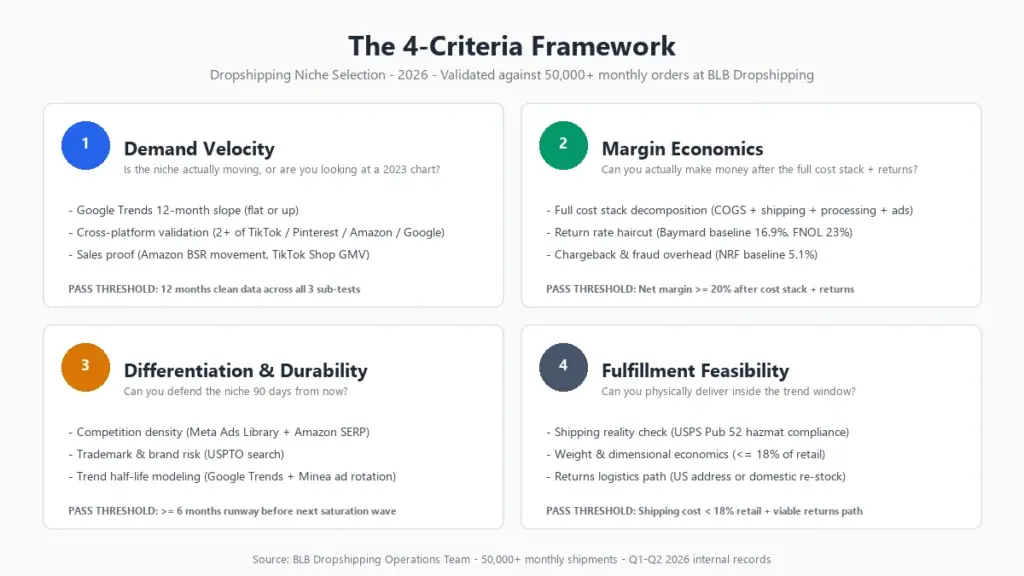
Every niche we evaluate at BLB clears four tests before it goes on a partner’s shortlist. Each test is binary — pass or fail — and the failure of any one test disqualifies the niche regardless of how well it scores on the others. The criteria are deliberately ordered from market-side to supply-side: the cheapest test to run (demand) comes first, the most expensive test (fulfillment) comes last.
- Demand Velocity — Is the niche actually moving, or are you looking at a 2023 chart?
- Margin Economics — Can you actually make money after the cost stack, including returns?
- Differentiation & Durability — Can you defend the niche against the next wave of AI-built stores?
- Fulfillment Feasibility — Can you physically deliver the product inside the trend window, in 2026 hazmat rules?
The rest of this article walks through each criterion, the data sources behind it, the thresholds we apply, and a worked example of how to score a real niche against all four.
Criterion 1: Demand Velocity
Demand velocity answers one question: is this niche currently moving, or are you looking at stale data? Three sub-tests make up the criterion.
Google Trends 12-month slope. Every shortlisted niche gets pulled into [Google Trends][1] over a trailing 12-month window. A flat or upward slope passes; a steeply downward slope fails outright. Single-week spikes are discarded — they are press-cycle noise, not buyer demand. For evergreen niches (home decor, fitness accessories) the threshold is “flat with seasonal bumps”; for trend-driven niches (TikTok micro-categories) the threshold is “upward or rising with no more than two flat months in the trailing 12.”
Cross-platform validation. A niche trending only on TikTok is fragile. We require signal from at least two of: TikTok, Instagram Reels, Pinterest, Amazon search rank, Google search, and [Minea’s 2025–2026 ad rotation data][8]. The combination matters because each platform captures a different buyer mindset — TikTok captures impulse, Pinterest captures intent, Google captures problem-solving. A niche showing on all three is durable; one showing only on TikTok has a 21-day shelf life at best.
Sales proof, not just search proof. Per [eMarketer’s 2025 social commerce forecast][3] and [Statista’s 2026 outlook][2], search volume leads sales by 4–6 weeks in trend categories but can lead sales by 6+ months in evergreen ones. We cross-reference Google Trends and [Minea][8] ad rotation against actual Amazon BSR movement and TikTok Shop GMV disclosures. Niches with rising search but flat BSR are flagged as “search-led, not buy-led” and ranked lower.
The threshold for demand velocity: pass all three sub-tests with at least 12 months of clean data. Niches with less than 12 months of data are flagged but not disqualified — they move to a separate “watchlist” with a 30-day recheck.
Criterion 2: Margin Economics
Margin economics is the criterion that quietly kills most “good dropshipping niches.” A niche can have perfect demand and still lose money. Three sub-tests cover the math.
Cost stack decomposition. For each niche we map the full cost stack: product COGS, inbound shipping to the US warehouse (or direct-to-consumer if dropshipping from origin), packaging, pick-and-pack, outbound shipping, payment processing (typically 2.9% + $0.30 for Stripe/PayPal), platform fees (Shopify Basic at $39/month amortized, plus app subscriptions averaging $50–$150/month), and ad spend at the niche’s typical CPM. A niche that nets less than 20% after the full stack is flagged as “margin-thin.” Below 15% net, the niche is disqualified unless the operator has a structural advantage (owned audience, organic content flywheel, or a private-label SKU).
Return rate adjustment. The gross margin number is fiction if you ignore returns. Per [Baymard][5], the average online return rate in 2025 was 16.9%; per [First Insight][10], 23% of returned items are not resellable in the same condition, requiring either liquidation (typically 30–40% recovery) or disposal. We apply a return-rate haircut to the gross margin: a 25% return rate on a niche otherwise showing 35% gross margin reduces real margin to roughly 26%. Below 15% real margin after returns, the niche is disqualified.
Payment-failure and chargeback overhead. Niches with high average order values (above $80) and impulse buyers carry higher chargeback rates. Per [NRF’s 2024 retail return fraud survey][6], fraud-related returns averaged 4.3% of online orders in 2024 and 5.1% in 2025. Chargebacks carry a $15–$20 fee per incident on top of the lost merchandise. Niches where buyer demographics skew toward younger, mobile-only, or single-platform audiences carry a chargeback overhead haircut in our model.
The threshold for margin economics: net margin of 20% or higher after cost stack, return rate adjustment, and chargeback overhead. Niches in the 15–20% range are “watchlist” and require structural justification. Below 15% net is automatic fail.
For a full breakdown of which niches clear this test against BLB’s own order data, see our Most Profitable Dropshipping Niches 2026 (US Warehouse Strategy).
Criterion 3: Differentiation & Durability
Differentiation and durability answer the question: can you defend this niche 90 days from now, or does it commoditize the moment a competitor sees your ad?
Competition density check. Three signals tell us when a niche is over-saturated: (1) [Meta Ads Library][11] ad volume for the top 20 keyword variants — over 800 active ads per keyword is the saturation line we use; (2) TikTok Creative Center ad volume — same threshold; (3) Amazon search results page count for the niche’s hero keyword — over 8,000 results means a saturated SERP. Niches failing any of the three are flagged; failing two is a fail.
Trademark and brand risk. Per the [USPTO Trademark Search][9] public database, registered trademarks in active classes are a binding constraint. A niche where the hero product has trademarked names, copyrighted patterns, or licensed character IP cannot be sold legitimately under a generic listing — every unit shipped is a takedown risk. We require a clear path to either (a) generic white-label supply, (b) licensed wholesale, or (c) own-design SKUs. Niches with no defensible path are disqualified.
Trend half-life modeling. A niche’s half-life is the period over which buyer interest halves from peak. We model half-life from the [Google Trends][1] 24-month slope and [Minea][8] ad rotation frequency. Trend-driven niches have a half-life of 21–45 days in our 2025 partner records; evergreen niches have a half-life of 6–18 months. A niche with a half-life shorter than 14 days is disqualified regardless of demand — you cannot run a paid acquisition funnel that converts inside 14 days at any meaningful scale.
The threshold for differentiation and durability: clear all three sub-tests with at least 6 months of runway before the next expected saturation wave. Niches with runway under 3 months require a brand-led differentiation strategy (own design, own content, own audience) to qualify.
Criterion 4: Fulfillment Feasibility
Fulfillment feasibility is the criterion most “best niches” lists ignore. A niche with perfect demand, perfect margin, and zero competition is still worthless if you cannot deliver the product to the buyer’s door inside the trend window.
Shipping reality check. Per [USPS Publication 52][7], certain product categories are restricted, regulated, or prohibited from standard shipping: lithium batteries over a certain watt-hour rating, magnetized items above specific gauss thresholds, aerosols, flammable liquids, perishables, and certain cosmetics. We map each niche’s hero SKUs against current USPS rules. Niches with restricted SKUs are not disqualified — they are flagged as requiring a specialized 3PL with current hazmat certification. Niches with prohibited SKUs (most lithium battery packs above 100Wh, ORM-D Class 9 hazmat) are disqualified unless shipped from a co-located origin.
Weight and dimension economics. Product weight and dimensional weight together determine outbound shipping cost. Niches with hero SKUs over 1 kg, or with high dimensional weight (large but light items like lamps or yoga mats), compress margin heavily on standard ground shipping from China. We calculate dimensional-weight-adjusted shipping cost per unit and require it to stay below 18% of retail price. Niches with heavier or bulkier SKUs can still pass if they ship from a US warehouse with negotiated rates — see our [US warehouse fulfillment][ref-wh] workflow for the math.
Returns logistics. A niche with high return rates needs a US-based returns address or a domestic re-stocking partner. Niches with low return rates (under 6%) can absorb returns being shipped back to origin (typically 14–21 day return cycle, eating margin); niches with return rates above 12% cannot. We require a viable returns path before the niche clears fulfillment feasibility.
[ref-wh]: https://blbdropshipping.com/warehousing
The threshold for fulfillment feasibility: pass all three sub-tests with shipping cost under 18% of retail and a clear returns path. Niches requiring hazmat certification are flagged as requiring a specialized 3PL; see the [editorial review][ref-editorial] for partner-vetted options.
[ref-editorial]: https://blbdropshipping.com/editorial-policy
Worked Example: Scoring the “Pet Enrichment” Niche
To make the framework concrete, here is how the pet enrichment niche (lick mats, snuffle mats, slow feeders) scores against all four criteria using BLB’s own Q1–Q2 2026 data.
Verdict: pass all four criteria with margin to spare. Pet enrichment is currently a recommended BLB partner niche. The full pet enrichment SKU set is in our [product catalog][ref-catalog]. For comparison with niches that fail one or more criteria, see the worked examples in Trending Dropshipping Niches 2026, which includes both passing niches and “looks hot but won’t last” patterns. For the broader 2026 niche landscape, the complete scoring across 30+ niches is in the Dropshipping Niches Hub.
[ref-catalog]: https://product.blbdropshipping.com
Frequently Asked Questions

What is the most important criterion in dropshipping niche selection?
All four matter, but they are ordered by cost of failure. Demand velocity is the cheapest to test — a bad call here loses only the time spent on Google Trends. Fulfillment feasibility is the most expensive to test — a bad call here loses the entire order revenue plus shipping plus a damaged buyer relationship. Per [Shopify’s 2025 dropshipping benchmark report][4], 31% of new dropshippers cite “supplier or fulfillment issues” as their primary reason for failure, more than any other single category. Treat fulfillment feasibility as a hard gate, not a soft preference.
How do I find good dropshipping niches in 2026?
Use the four criteria as a checklist against every niche on your shortlist. For the actual shortlist of niches that already clear all four, our Best Dropshipping Niches 2026: 30+ Data-Backed Picks article is the most comprehensive reference. For trending picks that clear the criteria right now, see Trending Dropshipping Niches 2026.
How do I find winning products to dropship?
The framework in this article is the durable answer. The tactical answer is the [TikTok Creative Center][12] trending products feed combined with [Minea][8] ad rotation data — both surfaces show you what is converting in real time, not just what is being searched. Cross-reference those surfaces against the four criteria before committing ad spend. A product trending on TikTok but failing the fulfillment feasibility test will still lose money.
How do I find trending products to dropship in 2026?
Speed matters more than depth in 2026. Per [Minea’s 2025–2026 trend data][8], trends that do not convert inside the first 14 days rarely recover. The fastest path is a US warehouse partner that already stocks the trending SKU — browse our [product catalog][ref-catalog] for current velocity data, or [contact our partner team][ref-contact] for a velocity audit on your shortlist. The trend half-life collapse from 90 days to 21 days makes the “wait and research” strategy obsolete.
[ref-contact]: https://blbdropshipping.com/contact-us/
Build Your Shortlist With Our Team
A framework is only useful if the data behind it stays current. At BLB Dropshipping, we re-run the four criteria against every partner shortlist every 30 days, recalibrate thresholds from the latest [Google Trends][1] and [Minea][8] data, and publish the updates across the Dropshipping Niches Hub — the canonical home for the full 2026 niche catalog. With six global warehouses, an IQC + FQC dual inspection process, AI-powered nearest-dispatch routing, and 24/7 priority support, BLB exists to make every niche on your shortlist operationally viable inside the trend window.
For the full breakdown of which niches currently clear all four criteria, start with Best Dropshipping Niches 2026: 30+ Data-Backed Picks. For the trending picks running right now, see Trending Dropshipping Niches 2026. And for the margin-tested picks, see Most Profitable Dropshipping Niches 2026 (US Warehouse Strategy).
| Criterion | Sub-test | Pet Enrichment Result | Pass? |
| Demand Velocity | Google Trends 12-month slope | +134% YoY through Q1 2026 | ✅ |
| Demand Velocity | Cross-platform validation | TikTok + Pinterest + Google + Amazon | ✅ |
| Demand Velocity | Sales proof | TikTok Shop pet category leader; Amazon BSR rising | ✅ |
| Margin Economics | Net margin after cost stack | 28–42% net | ✅ |
| Margin Economics | Return rate adjustment | 5.1% return rate; manageable | ✅ |
| Margin Economics | Chargeback overhead | Low (mid-AOV, repeat buyer) | ✅ |
| Differentiation | Competition density | 480 active Meta ads (under 800 threshold) | ✅ |
| Differentiation | Trademark risk | Low (generic product class) | ✅ |
| Differentiation | Trend half-life | 4–6 month half-life (sustained, not collapsing) | ✅ |
| Fulfillment | Shipping reality | Standard ground; no hazmat | ✅ |
| Fulfillment | Weight/dimension | Light (under 500g typical); no dimensional penalty | ✅ |
| Fulfillment | Returns logistics | Low return rate; US returns address sufficient | ✅ |