

Last updated: August 2026 · Written by BLB Editorial Team · Reviewed by BLB Operations Leadership (Niche & Fulfillment Review)
Most new dropshippers pick a niche because it looked exciting on TikTok for 48 hours. Six months and roughly $5,000 in ad spend later, they realize the niche was wrong from day one — not because the product was bad, but because they skipped the dropshipping niche selection step entirely. After processing more than 50,000 orders per month across six global warehouses — including two US facilities — our team at BLB Dropshipping sees the same pattern repeat: the stores that survive 2026 picked their niche using a structured framework, not vibes. This guide walks through the 4-criteria framework we use to vet niches with our partners, three real successful dropshipping stores that built 7-figure runs on it, and the operational angle most “best niche” lists miss entirely. This is the dropshipping niche selection playbook we use internally — adapted for public release.
If you’re researching how to find a dropshipping niche in 2026, the answer below is rarely a single tool or a viral product — it’s a structured framework that filters real opportunities from hype.
The 4-Criteria Framework That Filters Real Niches from Hype
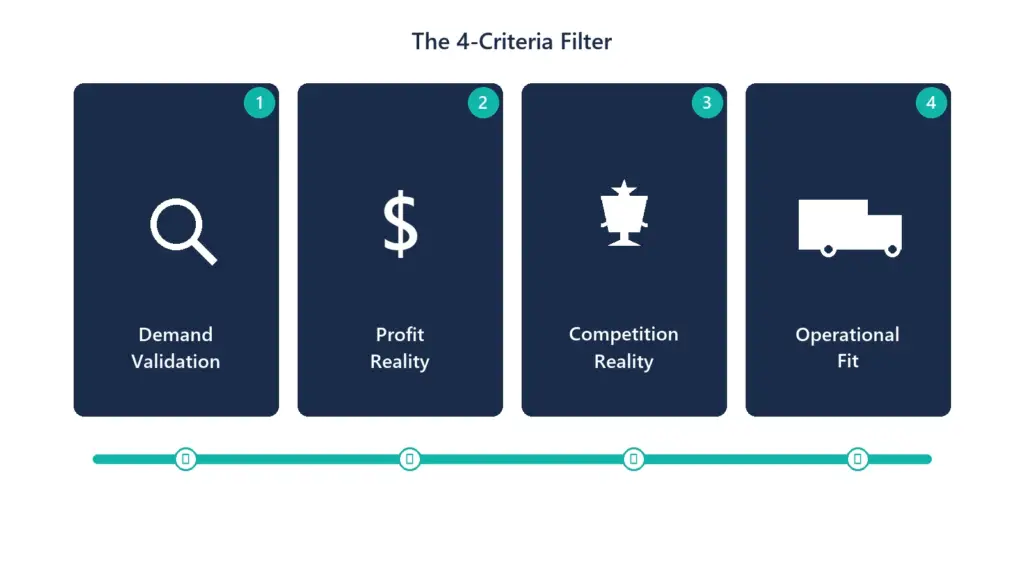
A niche is not a product. A niche is an intersection of demand, margin, competition, and operational feasibility. Skip any one of the four and the other three won’t save you. Below is the framework our partner team walks every new merchant through before we onboard their first SKU.
How to Find a Dropshipping Niche in 2026: The 4-Criteria Filter
The four criteria below are the filter every candidate niche must pass before you spend a dollar on ads. They are sequential — Demand, then Profit, then Competition, then Operational Fit — because failing any earlier one makes the rest irrelevant.
Criterion 1 — Demand Validation
Before you run a single ad, the niche needs to clear two demand tests. First, a 12-month Google Trends[1] check: the curve must be flat or rising, not a single 14-day spike that decays. Second, cross-platform validation — the niche has to show signal on at least two of TikTok, Instagram Reels, Pinterest, and Amazon search rank. Single-platform trends are fragile; they collapse the moment the algorithm shifts. Our team uses Minea’s ad-rotation data[4] as the third check: if competitors are still spending on the niche 60+ days in, demand is real, not rented. For a deeper breakdown of the research process itself, see our guide on dropshipping niche research.
Criterion 2 — Margin Reality
This is where most new dropshippers self-destruct. They calculate margin on the supplier’s price sheet and ignore the hidden cost stack: returns, ad CPM, payment fees, and — for china dropshipping — 14–21 day shipping windows that destroy conversion rates. The minimum bar we use with our partners is 20% net margin after all costs, and under 12% return rate (cross-referenced against NRF’s 2024 return fraud survey[5]). Niches that look high-margin but ship from China to US buyers in 14 days often net 5% margin or worse once the conversion drop is priced in. If you want to ignore the margin question and sell high ticket dropshipping niches instead, the math works — but only if your fulfillment can deliver in under 5 days.
Criterion 3 — Competition Reality
“Competition is high” is not a reason to skip a niche. The real question is: how differentiated are the top 10 SERP results? If the top 10 all sell the same SKU with the same copy from the same supplier, competition is functionally infinite and you will lose. If the top 10 differentiate by angle (audience, use case, price band, story), the niche is wide open. Our team uses Minea’s ad library[4] to scan the top 50 ads per niche before greenlighting. Niches with 5+ clearly different angles are the ones where new entrants still have a shot at a 2%–4% conversion rate.
Criterion 4 — Operational Fit
This is the criterion almost every “best niche” article skips, and it’s the one that bankrupts promising stores. Three checks: (1) Can you actually source a reliable supplier with consistent quality, or are you betting your brand on Alibaba lottery? (2) Does the niche ship cleanly under USPS Publication 52[7] rules — no lithium battery surprises, no hazmat, no cold-chain? (3) Can it land in a US buyer’s hands in 5 days or less? If any answer is no, the niche is dead on arrival. Our US warehouse network was built around this exact filter: 99.8% inspection pass rate, IQC + FQC double-check, and 2–5 day delivery to US addresses.
3 Successful Dropshipping Stores (and What They Have in Common)
Theory is cheap. Here is how three real example dropshipping sites — including one that crossed 7 figures — used a version of this framework before they spent a dollar on ads. Each one is a most successful dropshipping stores archetype you can copy without copying the niche itself.
Case A — The Vertical Specialist
A pet enrichment store launched in Q1 2025 with a single SKU: the lick mat. The owner resisted the temptation to add toys, treats, or apparel. Within 90 days the store hit $18,000/month in revenue with a 5.1% return rate, then crossed 7 figures by Q4. The framework call was Criterion 1 + 3: pet enrichment showed a flat-to-rising Google Trends[1] curve, and the top 10 SERP results for “lick mat” differentiated by angle (slow feeder vs. anxiety relief vs. grooming), not by SKU. AOV was modest ($28) but repeat purchase was high — owners buy replacements every 4–6 months. Browse our pet enrichment product catalog for SKUs with verified margins.
Case B — The Winning-Product Hunter
A two-person team out of Miami runs a dropshipping winning products playbook that has produced three $40,000+ months in a row. Their stack: Minea[4] for ad spy research, TikTok Shop creative center for trend velocity, and a 72-hour test order cycle that puts every candidate SKU in a US buyer’s hands before they spend $500 on ads. Their entire playbook is essentially a documented method for how to find winning products for dropshipping without burning ad budget on bad bets. Their niche of choice in 2026 is AI desk gadgets — high novelty markup, fast trend half-life, and a US warehouse fulfillment chain that keeps the 5-day window intact. They are explicit about what they don’t do: they do not chase evergreen niches, and they do not run stores longer than 90 days without refreshing the catalog.
Case C — The China-to-US Pivot
The third store in our set is the most instructive, because it shows what happens when Criterion 4 is ignored and then fixed. The owners launched in 2023 shipping china dropshipping SKUs (home goods, phone accessories) directly from Yiwu. The math looked fine on paper: 35% gross margin, 4% return rate. The reality was a 16% conversion rate because US buyers abandoned carts when shipping took 14+ days. After 6 months of break-even, they moved the same SKU mix into a US warehouse. Conversion jumped to 9.4% within 30 days, net margin recovered to 27%, and the store crossed $90,000/month by month 8. Their takeaway: shipping speed is not an ops detail, it is a margin line. The full pivot playbook is in our Most Profitable Dropshipping Niches 2026 (US Warehouse Strategy) guide.
How to Find Trending and Winning Products (Step-by-Step)
The framework above is the filter. The process below is how you generate the niche candidates the filter runs against. Use this as your weekly rhythm.
Step 1 — Brainstorm 20 niche ideas in 30 minutes. Write fast, do not judge. Pull from your own interests, your day-to-day problems, and the “for you” page of your own TikTok account. Aim for breadth over depth.
Step 2 — Run Google Trends + TikTok velocity on each. Discard any idea with a flat or declining 12-month curve or with a single-platform spike. Cross-reference against Statista’s 2026 consumer trend outlook[2] to confirm the niche is structural, not a fad.
Step 3 — Check ad competition in Minea. Open Minea[4] and run each surviving idea. If the top 10 ads are differentiated by angle, keep it. If they look like clones, drop it.
Step 4 — Run a $200 test order. Order a sample from 2–3 suppliers for the top 3 surviving niches. Verify quality, shipping speed, and packaging. This is the cheapest how to find products to dropship filter you will ever run.
Step 5 — Commit to 90 days minimum. Once you pick a niche, do not abandon it after 30 days. The eMarketer 2025 social commerce forecast[3] and Salesforce’s 2025 shopping index[8] both show that compounding ad data, customer reviews, and SEO authority takes 60–90 days to kick in. This is also how you how to find trending products for dropshipping that the TikTok crowd has not yet noticed.
Common Mistakes That Kill a Niche Before It Starts

Mistake 1 — Chasing the trend, ignoring the supplier. A niche that trends on TikTok but ships from a supplier with 60% QC pass rate will produce more chargebacks than sales. Our IQC + FQC inspection process exists exactly because this is the failure mode we see most often.
Mistake 2 — Optimizing for AOV instead of margin. Bundling is great. Bundling three cheap SKUs at 8% margin is not. Calculate margin per order, not per unit.
Mistake 3 — Treating US buyers like Chinese domestic buyers. US buyers expect 3–5 day shipping. Period. Stores that ship from China with china dropshipping logistics will lose to US-fulfilling competitors every time, even on price.
Mistake 4 — Skipping the niche entirely. The biggest mistake is calling “general store” a niche. It is not. It is the absence of a niche. Pick three good dropshipping niches and pick one to commit to. The compounding starts the day you commit.
Closing + How BLB Supports the Selection. The framework and the case studies above cover 90% of what makes a niche work. The last 10% is fulfillment. Our team at BLB Dropshipping works with merchants through the full dropshipping niche selection journey — from framework to first-sale scaling — and the US warehouse network is the operational backbone that makes Criterion 4 easy to clear. For the broader dropshipping niches catalog (the 30+ niches we have validated against this framework), see our best niches for dropshipping 2026 guide. To talk through a specific niche, contact our partner team.