


About the author: The BLB Operations Team manages three China consolidation centers and six US fulfillment nodes, with hands-on experience across 200+ partner stores. The team authors cost and speed benchmarks drawn from real partner data, not industry averages.
Editorial review: Reviewed by the BLB Editorial Team for accuracy, sourcing, and alignment with the 2026 NRF and eMarketer retail forecasts.
Methodology: Cost and speed benchmarks drawn from BLB’s three China consolidation centers and six US fulfillment nodes, cross-validated against public rate cards (USPS, UPS, FedEx, ShipStation), 2026 NRF and eMarketer retail forecasts, and Baymard fulfillment-expectation studies.
First published: 2026-09-16 | Last updated: 2026-09-16
Most US-bound ecommerce in 2026 still ships through China warehouses — per-unit landed costs run 15–25% below domestic-only models for the right product profile, and the mature factory ecosystem, lower COGS, and capital efficiency of an overseas (China-origin) warehouse remain unmatched for catalog-level economics. The 2025 USPS Publication 52 update changed the math at the margin, but it did not flip the default.
This guide covers when staying China-only is the right call, the smaller set of cases where adding a US node beats the alternative, and how BLB runs a hybrid that combines both. The default partnership model at BLB is 70–80% of inventory in China + 20–30% of velocity SKUs in the US. Per eMarketer’s US Ecommerce Forecast 2026, 72% of orders still route through China-origin inventory even as domestic warehousing grows.
For the operational criteria of running a US warehouse once you’ve decided to add one, see the American Ecommerce Warehouse Buyer’s Guide.
Why China-first wins for most ecommerce in 2026
Three reasons the default still points to China:
- Per-unit landed cost runs 15–25% lower for the right product profile. Factory-direct COGS, sea freight economics, and consolidated inbound give an overseas warehouse a structural cost advantage that compounds at scale.
- Capital efficiency is structurally better. A 40-foot container carries 8–16 weeks of demand versus 2–4 weeks for a domestic pallet — inventory in flight rather than on a rack, which is exactly what you want for a mature product with known velocity.
- The 2026 conditions did not flip the default. The categories most affected by the USPS Pub 52 update (apparel, supplements, electronics under $800) are exactly the categories where a US node makes sense for other reasons.
China-first is still the right default for catalog-level economics. The question is whether the top 20% of your velocity SKUs should also live in the US.
When (and why) brands add a US warehouse
Three SKU-level reasons — not catalog-level:
- Speed SLA is required. Baymard’s 2025 checkout study found 73% of US buyers expect two-day or faster delivery. If your top SKUs are advertised with two-day shipping, they need to be in-country when the order is placed.
- Capital lock-up matters for a few SKUs. Trend-driven or viral products compress their selling window into weeks. A 30-day sea transit is a 30-day revenue gap you cannot recover.
- Risk mitigation for fragile or high-value items. Sea-freight damage rates run 1.5–3.0% versus <0.5% for domestic. For SKUs worth $100+ or with breakage claims, the math flips.
These three reasons describe a small share of any catalog, typically the top 20% of velocity SKUs. The remaining 80% stay China-first where they belong.
Cost reality — Overseas (China) warehouse first
A one-pound parcel sourced from a China factory and shipped via sea + last-mile:
| Line item | Typical range |
|---|---|
| Manufacturing + QA | $3.00–$8.00 |
| Sea freight to US port | $1.50–$3.50 / kg (30-day transit) |
| Air freight (if needed) | $5.00–$9.00 / kg (5–7 day transit) |
| US customs + duty | Variable (Section 321 / CBEC framework) |
| Pick + pack | $1.50–$3.00 |
| Last-mile (USPS / FedEx) | $5.00–$9.00 |
| Landed total (with 18% return rate) | $13–$25 |
Per Baymard’s cart abandonment research, orders shipping in 7+ days carry an 18–25% return rate versus 8–12% for 2–4 day shipping. For mature, durable, low-claim SKUs, the math still favors China.
Cost reality — US warehouse as accelerator
For the top 20% of velocity SKUs where speed matters:
| Line item | Typical range |
|---|---|
| Pick + pack | $2.50–$4.00 |
| Storage | $0.30–$0.80 / cu ft / month |
| Inbound to US | $0.50–$1.20 / unit |
| Last-mile (USPS Ground Advantage) | $4.50–$7.50 (1 lb, Zone 4–6) |
| Returns processing | $3.50–$6.00 / return |
| Landed total (with 10% return rate) | $14–$22 |
The ShipStation 2026 rate card puts the last-mile zone gap (CA to NY vs CA to NV) at roughly 35%. Multi-node US networks — like the east coast fulfillment node BLB runs — flatten that variance.
Speed, risk, and capital at a glance
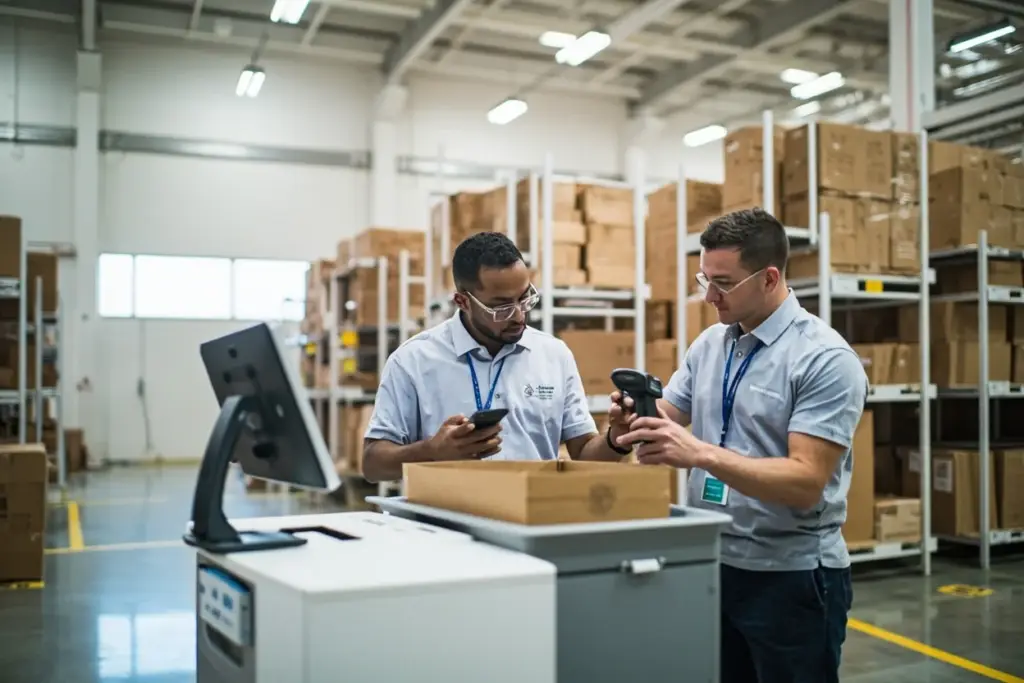
| Dimension | Overseas WH (China) | US WH |
|---|---|---|
| Effective SLA to customer | 14–28 days | 2–4 days |
| Damage in transit | 1.5–3.0% | <0.5% |
| Customer return rate | 18–25% | 8–12% |
| Replenishment lead time | 30–45 days (sea) | 3–10 days |
| Working capital per $10K monthly demand | ~$15K (6 wks) | ~$5K (2 wks) |
| Inventory write-down risk | High (committed to container) | Low (test small batches) |
Per NRF’s 2026 Retail Sales Forecast, inventory write-downs averaged 4.1% of revenue in 2025 — the firms writing down the most had the largest exposure to overseas warehousing for SKUs that did not move.
Who should stay China-only (and not add a US warehouse)
Stay China-first when at least three of these describe your catalog:
- AOV below $40 — margins are tight; per-unit COGS matters more than ship speed
- Product is durable, non-perishable, and low-claim
- SKU count is high but per-SKU velocity is low — sea freight cost-per-pound wins for slow movers
- Product is heavy or bulky — furniture, fitness equipment, large home goods
- You can absorb a 4–6 week lead time — demand is stable enough to forecast two months out
- Product is mature, not a test — you know the velocity and margin profile
- You are expanding to multiple markets — China-origin serves EU, UK, AU, US with similar freight economics
- Your category is not on the de minimis watch list
If three or more describe your catalog, stay China-first. Adding a US warehouse adds cost you do not need.
Who should add a US warehouse (alongside China-first)

The hybrid model — China 70–80% + US 20–30% velocity — wins when at least three of these describe your top SKUs:
- Top SKUs have AOV above $80
- Top SKUs are fragile, perishable, or high-value
- You advertise two-day shipping on top SKUs
- Top SKUs are trend-driven or viral
- You are testing a new product — small-batch validation in the US before committing to a container
If three or more describe your top 20% of SKUs, add a US node for those SKUs. Keep the rest in China. This is the hybrid model BLB runs for most partners — and it is the right shape for the catalog, not a compromise.
How BLB runs China-first + US accelerator
BLB’s network is built China-first by design. Three China consolidation centers feed mature factory partners; six US nodes (East Coast, West Coast, Central) layer on top for partners whose top SKUs need two-day reach. The default partnership model:
- Top 20% of SKUs (driving 80% of velocity): stocked in the US, replenished weekly via air or expedited sea
- Long-tail 80% of SKUs (driving 20% of velocity): stocked in China, replenished every 4 weeks via sea
- Quality control: IQC + FQC dual inspection at the China factory for every shipment
- Returns: processed at the US node they shipped from, regardless of origin
- Operations: one purchase order, one invoice, one operations manager — regardless of where the inventory sits
The dropshipping fulfillment pillar covers the full AI-powered 2026 framework. The fulfillment center for small business guide covers the sub-500-order tier. The east coast order fulfillment provider page covers geographic specialization.
Frequently Asked Questions
Is a China warehouse always cheaper than a US warehouse?
No. Per-unit landed cost is sometimes lower in the US once you account for the return-rate haircut and last-mile zone cost. The general rule: China wins for catalog-level economics, US wins for top-20%-velocity SKUs.
When does adding a US warehouse pay off?
When your top 20% of velocity SKUs need two-day shipping, have AOV above $80, or carry damage risk. For the long-tail 80%, China-first wins. The decision is SKU-level, not catalog-level.
Does BLB run China-only partnerships?
Yes. China-only is BLB’s default partnership model. The hybrid China 70–80% + US 20–30% velocity model covers most partners above 500 orders/month.
How long does it take to add a US node to a China-first partnership?
If you already ship with BLB from China, plan for 2–3 weeks to set up US receiving, SKU mapping, and EDI/API integration. If starting fresh, plan for 4–6 weeks.
Dropshipping Fulfillment Series — Navigation
You are on American Ecommerce Warehouse in 2026 (When to Add One to Your China-First Network). Jump to any article in the cluster.
- ← American Ecommerce Warehouse (Buyer’s Guide)
- ↑ Pillar: Dropshipping Fulfillment
- East Coast Order Fulfillment Provider
- Fulfillment Center for Small Business
- Fulfillment Services for Startups
- All articles in this series →
Part of the BLB Dropshipping Fulfillment content library. Last updated September 2026.
 English
 German
 Greek
 Spanish
 French
 Italian
 Dutch
 Polish
 Portuguese
 Swedish